Customer-ready jewelry visuals from Gemvision Matrix CAD views.
Gemvision Matrix is jewelry CAD for developing custom rings, settings, stone layouts, and detailed one-of-a-kind pieces. Its MatrixGold successor continues the Matrix design approach with parametric, history-based modeling, reusable parts, gem-setting tools, and production preparation. The CAD view remains the practical source for the approved geometry; a carefully prepared image can make that work easier for a customer or sales team to understand.




Gemvision Matrix is jewelry CAD for developing custom rings, settings, stone layouts, and detailed one-of-a-kind pieces. Its MatrixGold successor continues the Matrix design approach with parametric, history-based modeling, reusable parts, gem-setting tools, and production preparation. The CAD view remains the practical source for the approved geometry; a carefully prepared image can make that work easier for a customer or sales team to understand.
Gemvision Matrix is well suited to custom jewelry conversations where a designer must show how a ring, pendant, or setting comes together before it is made. A useful presentation view may show the ring profile and shank, the center stone and prongs, the gallery beneath the setting, a halo or side-stone arrangement, or an engraving detail. RENDERCAD can use an approved Matrix viewport capture as the visual starting point and create a more polished, customer-facing interpretation with an appropriate metal finish, gemstone character, lighting, and background. This fits design proposals, revision reviews, product-listing concepts, and marketing mockups for a specific piece. It complements Matrix or MatrixGold rather than replacing its own Render Studio, modeling tools, or manufacturing workflow.
Complete and review the jewelry model in Gemvision Matrix or MatrixGold first. Use the history-based model to make agreed changes, then select a camera angle that keeps the design decision legible: a three-quarter view for the overall silhouette, a side view for the head and gallery, or a close view for prongs, pavé, or engraving. Hide construction curves, dimensions, selection highlights, and unrelated scene objects. Capture a clean shaded viewport after confirming that the stone layout and metal geometry are correct. In RENDERCAD, describe the intended metal appearance, gemstone color and cut impression, lighting, background, and output context - for example, a customer proposal or product concept. Use the result to support discussion and presentation. Keep dimensions, stone sizes and placement, clearances, material specifications, print preparation, and manufacturing validation in Matrix or MatrixGold as the source of truth.
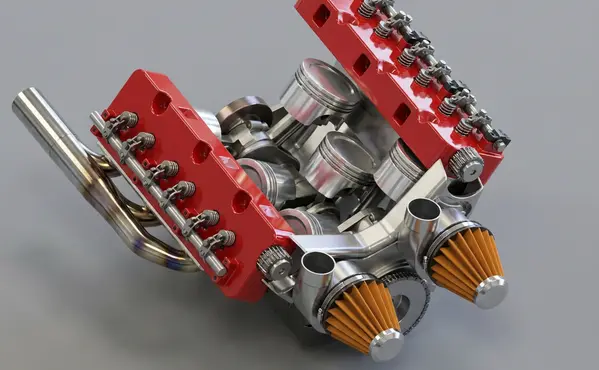
Modeled by CADSharp in Onshape. Rendered with RENDERCAD.
Add | Change | or Remove referenced objects with the stroke of a brush.
RENDERCAD uses a maintained selection of image-generation models for different rendering tasks. Results can vary by model and input, so compare generated output with the source design before relying on geometry, materials, or dimensions.
| Feature | RENDERCAD | Competitor |
|---|---|---|
| Engine | Generative AI | Varies by tool |
| Output | Images + Video | Varies by tool |
| Resolution | HD / 4K | Varies by workflow |
| Image Speed | Image renders complete in 60 seconds. | Varies by scene/tool |
| Video Speed | Videos complete in 2-5 minutes. | Varies by workflow |
| Scene Set Up | No separate local scene | Varies by workflow |
| Input | Screen Snip | Varies by tool |
| Hardware | Cloud GPU | Often local GPU/CPU |
| Install | None | Varies (web or app) |
| Cost | from $9/mo | Varies widely |
Read the numbers. We trust you to know theirs.
Skip a separate local scene build. Pick a condition, material, and background while RENDERCAD handles the image-generation step. Image renders complete in 60 seconds.
 ™
RENDERCAD™
™
RENDERCAD™
Use the browser workflow directly, capture a selected view with the desktop app, or start from the browser extension.
Get StartedCommon solutions for Gemvision Matrix users
Yes. Use a mask to target the background separately from the foreground product. Review both regions because generation can still alter unmasked content.
Share only reference images your team is authorized to use, together with the instructions and review criteria that produced a useful result. Reusing a reference can guide consistency but does not guarantee identical output.
Upload a clear image or use a current capture tool, describe carbon fiber, and add an authorized material reference when a specific visual direction matters. Image renders complete in 60 seconds.
Choose the Dusty condition and describe the intended atmosphere. Generated dust is illustrative, so review how it affects important product details.
Choose the Orbit camera preset in the Video panel. Review the generated clip because viewpoint changes and product details can vary from a single-image input.
Use the RENDERCAD Overlay to capture a clear viewport without rebuilding a separate render scene. Image renders complete in 60 seconds.
Yes. A current desktop capture app and browser extension are available, and the browser upload workflow remains available without either tool.
Use the Realistic engine with a clear input, a specific material description, and a suitable background or reference. Results vary, so review the output against the source product.
Generation runs on cloud infrastructure, so a local rendering GPU is not required. The laptop still needs a supported browser, network access, and enough resources for the source application and image upload.
The core workflow is available in a supported browser and accepts a selected 2D image, so it does not require a rendering plugin in the source application.
The model can reinterpret curves and surface transitions from the 2D input. Compare the result with the source because edges and geometry can drift.
It accepts a clear viewport screenshot, so a separate local material, light, and camera scene is not required for the image-generation workflow.